
Every article you’ll find on this question opens the same way: “It depends!” Then it either gives you a range so wide it’s useless, or it dangles a suspiciously low number to get you to call.
I’m going to do something different. I’m Donna Kreisler, and I own Affordable Heating and Air here in Chatsworth. I earned my C-20 license because I wanted to understand this trade from the inside, not just sell it.
So I’m going to give you real numbers, show you a real job with every line item, explain why the cheapest quote is almost always the most expensive decision, and hand you the same worksheet my team uses to decide whether you even need a replacement at all.
Let’s talk honestly about what this costs.
For a full system replacement in LA County, Ventura County, and the San Fernando Valley, most homeowners land somewhere between $9,000 and $22,000. The typical, middle-of-the-road job runs $11,000 to $13,000.
That’s a wide spread, so here’s what actually moves you along it:
The jobs that reach the $18,000–$22,000 top end are almost always about system efficiency and engineering specifications — premium, high-performance equipment sized and configured for a larger or more demanding home.
But here’s the first thing most articles won’t tell you clearly: “AC replacement” doesn’t mean one thing.
And that ambiguity is exactly what lets some contractors advertise a scary-low price.
If your setup is exactly right, a coil-and-condenser replacement can start as low as $6,000. That’s replacing the actual air-conditioning components while reusing your existing furnace or air handler, ductwork, and line set where possible.
When can you get away with that lower number? When you have the right conditions in place: good ductwork, the right existing equipment, and the right time of year. Everything lines up, and it’s a clean swap.
When is that lower number a false economy? When the rest of your system is aging right alongside the parts you’re replacing. Spending $6,000 to bolt new AC components onto a tired furnace and leaky ducts often means you’re back on the phone in a couple of years, paying labor all over again.
That’s the real reason a job climbs into the $9,000–$13,000 range: usually it’s about doing it once, doing it right, and taking advantage of the incentives available while a crew is already at your home. Which brings me to the most surprising thing in this whole article.
Most homeowners assume a like-for-like AC swap is always the cheapest path. In 2026, that’s frequently not true. We often recommend heat pump conversions because, after the rebate, the net cost can be lower than a simple coil-and-condenser changeout.
Here’s the logic. Say a 5-ton full system changeout runs $11,000 to $16,000, depending on the equipment. For this type of project, LADWP customers can now receive $5,000 to $6,250 back when they install a qualifying central ducted heat pump.
(LADWP offers $1,000 to $1,250 per ton for ducted systems, depending on efficiency. The higher $2,500-per-ton rebate is only available for top-tier ductless systems that serve the whole home).
Now think about it from a labor standpoint. When my crew is already at your home doing the work, you’re already paying for that labor. At that point, keeping an aging gas furnace usually doesn’t make financial sense — you’d be paying to preserve the very thing most likely to fail next.
Converting to a heat pump while we’re there, with that rebate applied, often pencils out to a lower net cost than the “cheaper” coil-and-condenser job that leaves your furnace untouched.
That’s not a sales pitch. It’s arithmetic. And it only works because of the incentive picture, which changed recently, so let’s get that right too.
I’d rather tell you the truth than repeat what half the HVAC websites out there still have posted:
We help you identify the programs you qualify for and get the paperwork moving. The final award always rests with the issuing authority, but you shouldn’t have to navigate that maze alone.
Before you spend a dollar on a replacement, you deserve to know whether you even need it. The honest truth is you can repair almost anything — but sometimes it’s not the best financial decision. So here’s the scoring worksheet my team uses.
Add up your points:
Add up your total:
Notice what this worksheet does not do: it doesn’t tell everyone to replace. If you’re at 8 points, we’ll tell you to repair, and we’ll mean it.
Here’s the most important thing I can tell you, and it’s the reason I wanted to write this myself.
If a quote is the cheapest, it’s almost always because the contractor is cutting corners somewhere on the install that never shows up on the contract. And cutting corners in your home is never the right decision.
Two examples my team sees constantly on other companies’ installs:
You can buy the best system in the world, but it’s only as good as the installation. Install it improperly, and it’s useless. That’s why comparing quotes on price alone is a trap — you’re not comparing the same thing.
Screenshot this and ask every contractor:
If the answers get vague, that’s your answer.
Let me show you what an honest, itemized quote actually looks like. This is a real recent heat pump changeout we did in Encino (91316) — a 1.5-ton AC Pro inverter heat pump paired with a new coil:
| Item | Price |
|---|---|
| Installation crew (1 day of labor) | $1,949 |
| AC Pro Y-series inverter heat pump condenser, up to 18 SEER2, R-454B | $2,750 |
| Y-series ceiling fan coil (1.5-ton) | $1,100 |
| Flush line-set | $150 |
| Electrical service disconnect box | $95 |
| SS2 secondary safety switch (shuts the system off if water backs up) | $110 |
| Electrical power whip | $105 |
| Contract price | $6,259 |
| Less LADWP rebate | – $1,050 |
| Net cost to homeowner | $5,209 |
Two things I want you to notice.
First, every line is written in plain English — the contract literally explains what a flush line-set is and what the safety switch does. You should never have to guess what you’re paying for.
Second, it’s honest about what isn’t included. Because we weren’t replacing the ductwork on this job, the quote says plainly that airflow and room-to-room comfort still depend on the existing vents — and that drywall patching isn’t in our scope.
That’s the opposite of the “we’ll add that later” change-order game. When you can see the exclusions in writing up front, there are no ugly surprises mid-job.
That Encino job actually started online. Through Affordable Air Direct (affordableairdirect.com) — our direct-pricing division, backed by the same C-20 license, you can get an instant HVAC system quote without waiting for a salesperson to call you back.
It is the same honest idea as the rest of this article: a streamlined online starting point that lets you see real pricing up front, before any in-home visit.
Here’s how it works, honestly: you answer a few questions about your home and system online (or by phone or Zoom), and you get a personalized quote right away. Then, before we ever install anything, we confirm the exact sizing with in-home pre-engineering so the final scope is right for your home.
The instant quote gives you a real number to plan around; the in-home step ensures that number is based on accurate measurements, not a guess. Starting online this way keeps the process efficient and the pricing transparent from the very first step.
To be clear about which path is which: Affordable Air Direct is the online-first starting point for replacement pricing. For repairs, maintenance, diagnostics, emergency service, or a traditional in-home consultation, reach Affordable Heating and Air directly at (818) 722-1332 for Los Angeles County or (805) 755-4074 for Ventura County. Both operate under the same California C-20 license (#1081403).
Almost nobody writes a check for a $6,000–$13,000 project, so the real question is usually “what does it cost per month.”
We work with multiple prime lenders, so real options exist:
(These are examples and are subject to credit approval — your actual rate and term depend on the lender and your credit.)
Here’s my honest take on when to finance. Financing makes sense when you’d rather put your cash toward something that earns you a better return, or when you simply don’t have the full amount available right now, and you need comfort in your home today. It is not about talking yourself into something you can’t afford. That’s a cash-flow decision, not a pressure tactic.
I’ll give you one story that stays with me. After her husband passed, a client of ours named Liz was suddenly handling everything alone when her furnace failed — in the middle of dealing with water damage she couldn’t afford to fix all at once. She told us she needed to save up and would call back.
Months later, we came out, and when we saw she was still without heat, we installed the furnace for exactly what she’d managed to save. No pressure, no upsell. That’s who we try to be. Your budget is real to us, and a good contractor meets you where you are.
A few things I’ll put in writing:
A full system replacement typically costs $9,000–$22,000, with most homeowners settling on $11,000–$13,000. A coil-and-condenser-only replacement can start as low as $6,000 when your existing furnace and ductwork are in good shape.
The sticker price can be higher, but after the LADWP rebate ($5,000 to $6,250 on a qualifying 5-ton central ducted heat pump), the net cost can be lower than a coil-and-condenser swap — especially since you’re already paying for labor while the crew is on site.
No. The federal 25C tax credit expired December 31, 2025, and does not apply to systems installed in 2026. Local and utility rebates, like LADWP’s, are where the savings are now. Check switchison.org for programs in your ZIP code.
Use the10-factor decision checklist above. Generally, if your system is under 10 years old and the repair is inexpensive, repair it. If it’s 15+ years old and repair costs are rising, replacement is usually the smarter economic decision.
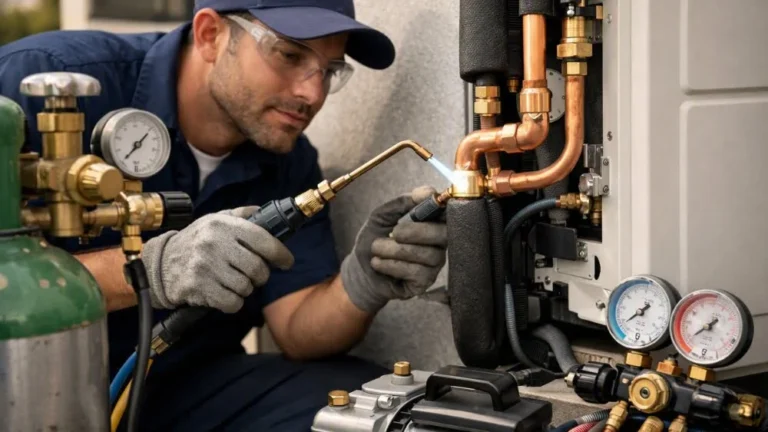
Almost always because that contractor is cutting corners on the install that never appear on the contract — like skipping the nitrogen purge or the deep vacuum. Those shortcuts don’t show up for years, and then the system fails early.
Our diagnostic fee is $95, and we apply it toward your repair. For a replacement, you can get an instant quote online through Affordable Air Direct, our direct-pricing division, and we always confirm the exact sizing with in-home pre-engineering before installing, so your number is based on real measurements, not a phone guess.
If you want a quote that’s itemized, honest, and sized for your actual home — not a phone guess or a lowball with corners cut — we’re here.
Get an instant HVAC system quote online at Affordable Air Direct, call us, or book online. Whichever way you start, we’ll walk you through your options, your rebates, and your numbers with zero pressure. That’s a promise.
— Donna Kreisler, Owner, Affordable Heating and Air · C-20 License #1081403 · Serving LA County, Ventura County & the San Fernando Valley