
Wildfire seasons in Los Angeles have become more severe in recent years, bringing smoke and dangerous particles into homes. On January 15, 2025, the Eaton Fire destroyed more than 9,400 properties and caused hazardous air, with PM2.5 levels reaching 569 µg/m³ in some areas.
You can’t control outdoor air quality during wildfires, but you can protect your indoor air to keep your family healthy and comfortable. Your home should be a safe place with clean air when smoke fills the area.
Read on to explore filtration options, technology solutions, and professional services that can dramatically improve your indoor air quality during wildfire events.
Wildfire smoke is made up of gases, tiny particles, and fine dust that can get into homes, even if they are well-sealed. The most dangerous are PM2.5 particles (smaller than 2.5 micrometers), which can get past the body’s defenses and reach deep into the lungs.
Most homes in Los Angeles let in a lot of smoke during wildfires. Without proper filtration, indoor particle levels can be 50-70% of outdoor levels. Even if you keep windows closed, you may still breathe polluted air unless you take extra steps.
Smoke particles can stay in your home even after the outdoor air seems clear. When your HVAC system runs, it can stir up and spread these particles again. Air that smells clean may still have invisible particles that can harm your health.
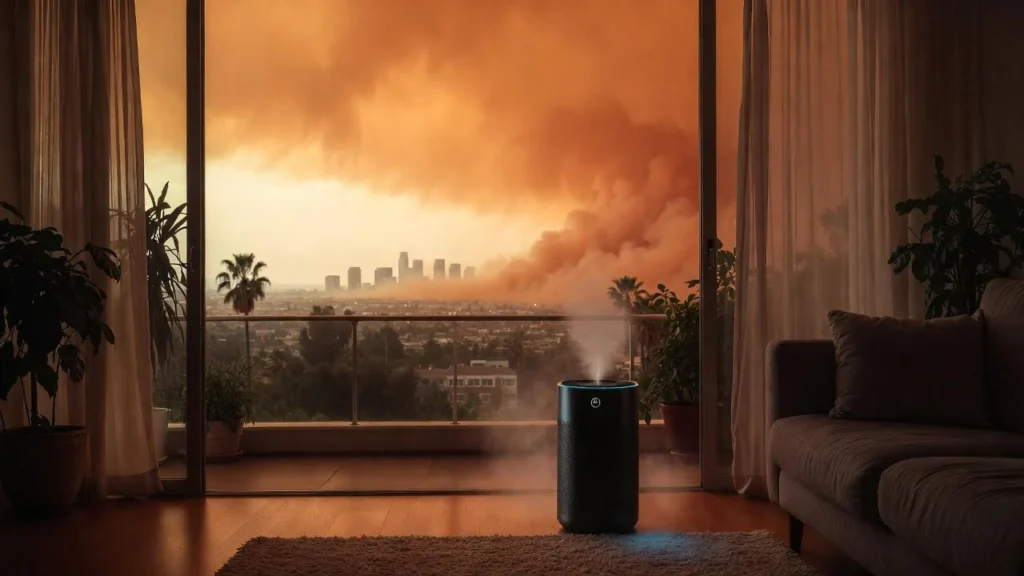
Children, older adults, people with asthma or COPD, and pregnant women are most at risk from indoor wildfire smoke in Los Angeles. Studies show that long-term smoke exposure during pregnancy may cause developmental problems.
Symptoms can include irritated eyes, a scratchy throat, headaches, worse asthma or COPD, tiredness, and trouble concentrating. These effects can persist even after the visible smoke has dissipated.
Hospital visits for breathing problems in Los Angeles increase by as much as 10% during and after major wildfires. The smallest PM2.5 particles can get into the bloodstream through the lungs and may affect the heart and other organs, not just the lungs.
Learn more about signs your indoor air is making you sick.
Standard HVAC filters (MERV below 11) catch less than 20% of wildfire smoke particles. These basic filters, which you often find at hardware stores, are made to protect equipment from large debris, not to protect people from tiny smoke particles.
MERV 13 filters can trap up to 85% of harmful particles and work with most home HVAC systems in Los Angeles County. A professional can check that your system can handle the upgrade without causing strain or reducing airflow.
Portable air purifiers with true HEPA filters give focused protection. Make sure the unit’s Clean Air Delivery Rate (CADR) matches the room size. For example, a model rated for 200 square feet won’t clean a 400-square-foot room well. Place purifiers in bedrooms and living areas where people spend the most time.
The California Air Resources Board (CARB) recommends using purifiers certified as ozone-free. Avoid ionic cleaners or older UV models that make ozone, since ozone can make breathing problems worse. CARB certification means the purifier meets California’s strict standards.
Many people in Los Angeles achieve the best results by using both whole-home HVAC filtration, such as MERV 13 filters, and portable HEPA units in key rooms. This gives your whole house basic protection and creates extra-clean areas, which is especially helpful at night for better sleep.
Unlike regular filters that just trap particles, air scrubbers actively break down contaminants using advanced oxidation. They can remove pollutants at the molecular level, including VOCs, odors, bacteria, and some viruses that bypass standard filters.
Air scrubbers built into your HVAC system protect against everyday indoor pollutants like cooking smells, pet dander, mold spores, and chemicals from furniture, even when there’s no wildfire smoke. This makes them useful all year in Southern California’s changing climate.
The best air scrubbers use UV light and specialized surfaces to generate short-lived oxidants that break down contaminants. These oxidizers quickly revert to harmless oxygen and hydrogen, leaving no chemicals behind.
When installed by a professional, air scrubbers cover all living spaces and clean the air several times an hour. This works better than using many portable units, offering more consistent results, less noise, and easier long-term maintenance.
True HEPA filters catch at least 99.97% of particles as small as 0.3 microns, including most wildfire smoke, allergens, and droplets that can carry viruses. This level of protection is trusted in hospitals and labs.
A whole-home HEPA system, installed by a professional, connects to your existing HVAC system and quietly filters all the air in your home. You won’t need loud portable units in every room or have to change filters as often.
If sized and maintained correctly, whole-home HEPA systems can lower indoor particle levels by more than 90%, even during severe wildfires like the 2025 Eaton Fire.
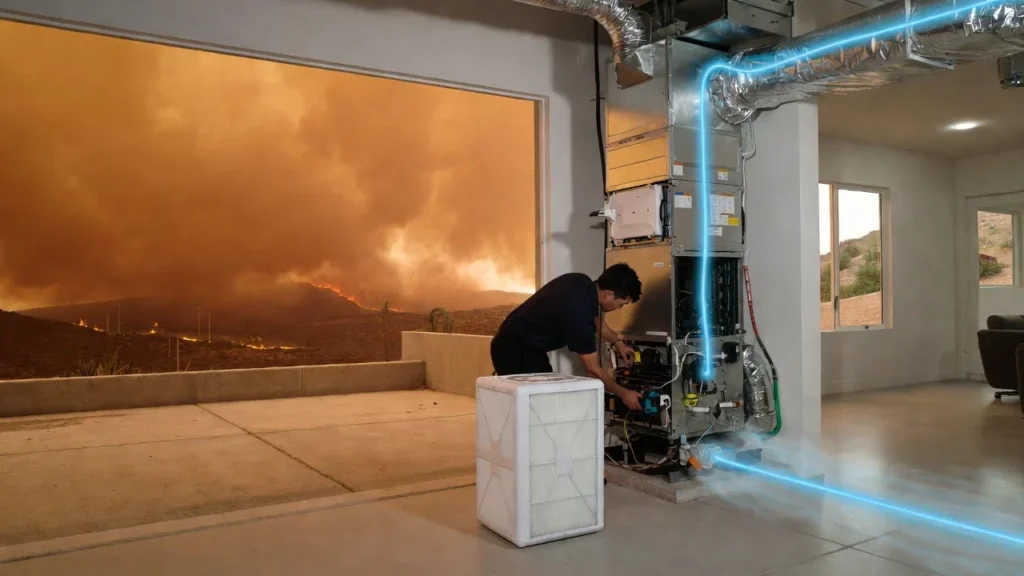
If you see smoke outside, keep windows and doors closed and set your HVAC to recirculate (do not use fresh-air intake). This helps keep polluted outdoor air from entering the building.
Choose a bedroom or a small room as a safe space. Seal gaps around windows and doors, use a portable HEPA purifier that fits the room size, and stay there during times when air quality is at its worst.
Check and change your HVAC filters more often during heavy smoke, ideally every week. Dirty filters can block airflow and send trapped particles back into your home. Replace them right away if airflow drops or they look clogged.
Check real-time air quality data for your area at EPA’s AirNow.gov. Stay indoors when the AQI is over 100, and only open windows to ventilate when the air quality improves a lot.
Professional testing can detect specific pollutants, such as formaldehyde, VOCs, carbon monoxide, and mold, that basic PM2.5 monitors may miss. This helps uncover hidden problems that general solutions might not catch.
Professional duct cleaning removes smoke residue that sticks to surfaces and keeps circulating long after outdoor air improves. This is especially important after big fires like those in 2025.
Technicians find and seal openings where smoke can enter, such as around windows, doors, and outlets. This not only keeps smoke out but also helps your home use energy more efficiently all year in Southern California’s changing weather.
Air quality in Los Angeles varies significantly during wildfire season. During active fire events, AQI can spike from healthy baseline levels (20 to 50) to hazardous (above 300), with PM2.5 levels exceeding safe thresholds within hours.
Santa Ana wind events can push smoke from distant fires into the LA basin with little warning. Outside of active fire events, AQI often returns to good or moderate levels, but burn-scar areas can still cause localized spikes during windy conditions. For real-time conditions, check AirNow.gov (EPA), IQAir.com, PurpleAir, or South Coast AQMD maps.
People in sensitive groups—children, seniors, and those with asthma or respiratory conditions—should monitor conditions closely and take protective measures early.
The right combination of measures can reduce indoor PM2.5 by 50 to 80 percent. Seal windows and doors and avoid using exhaust fans that draw outside air in.
Set your HVAC system to recirculation mode and upgrade to MERV 13 or higher filters. Use true HEPA air purifiers with activated carbon in key living areas — size them appropriately for each room. Designate a clean-air room and run a purifier continuously in that space during smoke events.
Avoid indoor pollution sources: no candles, frying food, or running gas stoves. Stay indoors when the AQI is unhealthy, particularly for children, seniors, and anyone with asthma or cardiovascular conditions.
If your home has a central HVAC system, a whole-house air purifier provides broader protection than portable units alone. Whole-house systems cover over 2,000 square feet, filter air in every room simultaneously, and remove smoke particulates, dust, and VOCs. Installation costs typically range from $800 to $3,000 and requires a licensed HVAC professional.
This solution is best suited for larger homes, households with members who have respiratory conditions, or homeowners who experienced direct wildfire exposure. Renters or those in smaller spaces should supplement with portable true HEPA units.
Yes. Air scrubbers are highly effective at removing heavy PM2.5, soot, ash, and VOCs through multi-stage HEPA and activated carbon filtration. They are most appropriate for post-fire cleanup or during heavy smoke events requiring aggressive air treatment.
Limitations: scrubbers are louder, bulkier, and more energy-intensive than home air purifiers, making them impractical for continuous everyday use. Rental costs in Los Angeles typically run $30 to $100 per day.
For ongoing wildfire season protection at home, portable HEPA purifiers are a more practical daily choice.
The Corsi-Rosenthal Box is a low-cost DIY air purifier (approximately $50 to $100) proven to reduce PM2.5 by 70 to 90 percent. You need a 20-inch box fan, four or five MERV 13 filters, and duct tape or zip ties. Stand the fan upright, tape the filters into a cube around the fan with the airflow direction facing inward, and run the fan on high for 200 to 500 CFM airflow — sufficient for 300 to 800 square feet.
Replace filters every one to three months depending on smoke exposure. This setup is particularly practical for renters or as an emergency backup option.
For wildfire smoke in Los Angeles, look for units with true HEPA filtration, substantial activated carbon (five pounds or more for severe smoke), high smoke CADR, CARB certification for California use, and a coverage area matched to your room size.
Well-regarded options include the Coway Airmega AP-1512HH Mighty for smaller rooms, the Blueair Blue Pure 311i Max for app-connected control, the IQAir HealthPro Plus for maximum smoke and VOC removal, and the Levoit Core 400S or Winix 5500-2 as cost-effective performers.
Budget for annual filter replacement costs of $50 to $100 per unit when comparing models.
Taking steps like upgrading your filters, installing air scrubbers, and keeping your HVAC system in good shape can protect you from wildfire smoke and improve your indoor air quality every day. These changes help all year, not just during fire season. With better air quality, your family can have fewer sick days, sleep better, focus more easily, and lower long-term health risks.
It’s important to get ready for wildfire season before the smoke arrives. By improving your home’s air filtration now, you make it a safe and comfortable place for your family when outdoor air quality worsens.
If you want advice on how to protect your home’s air quality during wildfire season in Los Angeles, contact Affordable Air and Heating. Schedule an appointment to check your current protection and find solutions that fit your home, budget, and family’s needs.