
Last updated: October 2026
If you are replacing a furnace, central AC, heat pump, or a full system in the City of Los Angeles, even if it is the same type as before, you must obtain a permit.
Most repairs to individual parts do not require one. In the city of Los Angeles, replacements must go through LADBS and usually need field verification testing, often called HERS testing.
This guide explains who needs a permit, how the process works, and what a closed permit means for getting an LADWP rebate.
Replacement work needs one; repair work usually doesn’t.
You need a permit to replace a furnace, central AC, or heat pump, even if you swap it for the same type.
You will also need one if you are replacing or making major changes to ductwork or installing a new mini-split.
Mini-split installations are not always simple express jobs. If you add any wall openings, line sets, or circuits, you may also require a separate electrical permit.
This rule applies to both homeowners and contractors, and you must get a permit before starting work.
You do not need a permit for the most common repairs, such as fixing a capacitor, contactor, fan motor, blower motor, control board, or thermostat; clearing a condensate line; or repairing and recharging a sealed system.
If this fits your situation, check out the AC repair cost in Los Angeles.
Title 24 and field verification rules apply across California. The only difference is which local office handles your permit.
| Where the property is | Who handles it | Notes |
|---|---|---|
| City of Los Angeles | LADBS | PermitLA for Express, ePlanLA for plan check. Includes Chatsworth, Granada Hills, Woodland Hills, Encino, and most of the San Fernando Valley |
| Other incorporated LA County cities | That city’s building department | Glendale, Burbank, Santa Monica, Beverly Hills, West Hollywood, Santa Clarita, Agoura Hills, and Calabasas each handle their own permits |
| Unincorporated LA County | LA County Building and Safety | Not LADBS |
| Ventura County | The city’s department or Ventura County Building and Safety | LADBS never applies here, and neither do LADWP rebates |
If you’re not sure which bucket you’re in, your property tax and water bills name the correct jurisdiction. If they say City of Los Angeles, use LADBS. Otherwise, use the city name on those bills.
Most residential replacements that use the same type and size of equipment in the same spot can get an Express permit through PermitLA. This applies if you retain the same fuel type, reuse existing ductwork, and make no structural changes.
The current rules cover systems up to 500,000 BTU/h, which is much larger than most home systems. If your project involves new duct design, moving equipment, adding zones, changing gas lines, upgrading panels, or installing a mini-split that does not fit the Express criteria, you will need a plan check.
Adding a new electrical circuit, common for heat pump conversions and mini-splits, also requires a separate permit.
If a licensed contractor is doing the work, they should pull the permit, and LADBS won’t issue a contractor permit to an unlicensed operator. Homeowners can also pull an owner-builder permit for work they do themselves.
These are typical timeframes, not guarantees: Express permits are usually processed within the same day or a few business days. Plan checks often take several weeks.
When the job is finished, you should have five items: the closed or final-approved permit record, the CF2R installer certificate, the CF3R rater certificate, the matched AHRI certificate, and your equipment warranty registration. Any competent contractor should provide all of these.
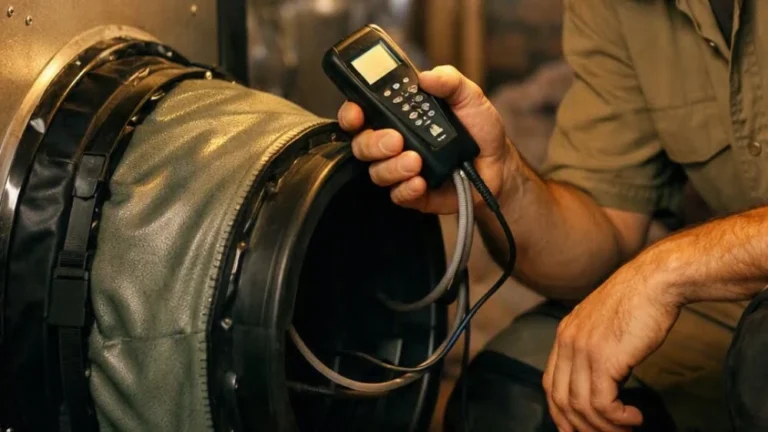
An independent rater checks if your new system was installed as described in the paperwork. In the 2025 code, this is called ECC, which stands for Energy Code Compliance. The tests are the same, just under another name. Most people still call it “HERS testing,” so both terms are used here.
Three documents move through this process: the CF1R compliance document filed with the permit application, the CF2R installer’s certificate confirming what was installed, and the CF3R independent rater’s field verification confirming it was installed correctly.
The allowed amount of duct leakage depends on the work done. A brand new or fully replaced duct system must have 5% or less leakage. If you are changing or adding to an existing system, it must have a total leakage of 10% or fewer, or a leak of 7% or less from the outside.
If these levels cannot be met, the next step is to seal every accessible leak and pass a visual and smoke test. Many older Valley homes with original ductwork do not pass the first test and need sealing and retesting. This is common.
How the refrigerant charge is checked depends on the type of equipment. Heat pumps must be verified in all California climate zones. Regular air conditioners have a short list of zones, excluding coastal areas like Santa Monica and coastal Ventura. Do not assume the same rules apply everywhere.
Most up-to-date equipment uses R-454B or R-32 refrigerant and must comply with current LADBS A2L guidelines and EPA Section 608. Existing R-410A systems can still be serviced. For a full comparison, see R-454B vs. R-410A.
To check whether a past job has a valid permit, LADBS publishes a public permit lookup by property address. Search your address for mechanical HVAC work, inspection history, and whether the status reads final or closed, not issued or expired.
If you’re in escrow and see no record, or an unclosed one, that’s the next step before guessing. This lookup applies only to City of LA addresses; other cities use their own departments.
There are three separate costs, not just one. An Express permit with surcharge generally costs between $120 and $300, but always check the current LADBS fee schedule for the latest prices.
Plan checks, extra electrical permits, moving equipment, or legalizing unpermitted work will cost more. If your total is close to $1,000, it is a complex job, not the usual case. The rater charges separately, usually $150 to $350, and a failed duct test plus sealing and retesting adds to that.
Our replacement quotes include permit pulling, Title 24 paperwork, and rater coordination. For the full job cost, see the AC replacement cost in Los Angeles.
If you are unsure whether you need a repair or replacement, we offer a $95 diagnostic. If you proceed with a repair, this fee is credited toward the cost. This helps you decide which permit path to take.
A final, approved, and closed Building and Safety permit is required for LADWP’s AC and heat pump rebate. No closed permit, no rebate, regardless of performance. A matched AHRI certificate is also required.
Current amounts run $100 to $120 per ton for qualifying central AC, $1,000 to $1,250 per ton for qualifying central ducted heat pumps, and $1,500 to $2,500 per ton for qualifying ductless systems that serve the entire home.
Apply within 12 months of purchase; ADUs and new construction aren’t eligible. See our LADWP rebate guide.
None of this applies to Ventura County or SCE-only ZIP codes.
The federal 25C tax credit expired December 31, 2025, and TECH Clean California and HEEHRA single-family funds are fully reserved, and South Coast AQMD’s GO ZERO has Phase 2 funding but no open application portal yet.
LADBS may ask you to open up the work for inspection, perform corrections, or even reinstall parts if needed. Having an open or never-closed permit can make selling your home or applying for a rebate just as difficult as having no permit at all.
A rater cannot fix an unpermitted installation in one visit; making it legal afterwards is a separate process that takes more time and costs more, but it is possible. California law says you must disclose any known unpermitted work when selling your home.
It can also affect insurance claims or equipment warranties, depending on your policy and the manufacturer. If you’re rebuilding a home substantially damaged in the January 2025 Palisades or Eaton fires, Executive Order N-29-25 may let you permit under the 2022 code instead of the 2025 code, except for fire and life-safety requirements. Confirm with your building department.
If a contractor offers to skip the permit, they are not saving you money. Instead, they shift the risk to you. If someone claims a condenser swap does not need a permit, get a second opinion. Learn how to choose a trustworthy HVAC contractor.
Yes, including a like-for-like swap of the same size and type. LADBS requires it whether a homeowner or a licensed contractor does the work.
Yes, under the same LADBS rules as AC replacement. Most same-for-same furnace changeouts qualify for Express without a plan check.
Independent field verification of your installed system, covering duct leakage and, depending on equipment type, refrigerant charge. The current 2025 code paperwork labels it as ECC, though “HERS testing” is still the common term.
A simple Express permit plus surcharges typically runs from $120 to $300, in addition to a rater fee of $150 to $350. Plan check or added electrical work costs more. Confirm the current fees against the live LADBS schedule.
Yes. A final closed permit and a matched AHRI certificate are both required. No closed permit, no rebate, regardless of performance.
Both are low-GWP refrigerants. R-454B is more common in new ducted systems, while R-32 is more common in new mini-splits. Neither is a drop-in replacement for R-410A nor the other.
Yes, a mechanical permit and often a separate electrical permit for new circuits or line sets. Don’t assume it qualifies as a simple same-for-same Express without checking.
We handle the permit, coordinate with the rater, and give you a closed permit and all documentation when the job is finished. We do not leave you with promises to be made in the future.
If you are unsure whether you need a repair or replacement, our $95 diagnostic—credited toward any approved repair—will help you decide.
Los Angeles County: (818) 722-1332, 9601 Cozycroft Ave, Chatsworth, CA 91311.
Ventura County: (805) 755-4074, 749 California Ave, Simi Valley, CA 93065.