
Last updated: September 2026
Starting in 2026, new residential air conditioners and heat pumps use R-454B or R-32 instead of R-410A, since manufacturers stopped making R-410A equipment on January 1, 2025. If your current system uses R-410A, you don’t need to replace it.
It’s still legal to own, use, and service. This guide covers what has changed, what hasn’t, and how to decide whether to repair or replace your system if needed.
This article does not go into detail about full replacement or repair pricing. For that information, see AC replacement cost in Los Angeles and repair or replace your HVAC.
The main differences between R-410A, R-454B, and R-32 are their global warming potential and flammability class. These changes do not affect how your system feels in your home.
| R-410A | R-454B | R-32 | |
|---|---|---|---|
| 2026 status | No longer manufactured for new equipment; existing systems fully serviceable | Common in new ducted systems | Common in new ductless mini-splits |
| Approx. GWP | ~2,088 | ~466 | ~675 |
| Safety class | A1 (non-flammable) | A2L (mildly flammable) | A2L (mildly flammable) |
| Drop-in for R-410A? | — | No | No |
| What this means for you | Keep servicing a healthy system. | The standard for most new central AC and heat pumps | The standard for most new mini-splits |
GWP numbers are industry estimates and may vary by blend or source. Neither R-454B nor R-32 is completely risk-free or fully “green.” They have a lower impact than R-410A, which is why regulators required the change for new equipment.
No. You do not need to replace a working R-410A system just because new equipment uses a different refrigerant. The new rule only affects the manufacturing of new equipment, not ownership or servicing of what you already have.
Whether you should replace your system depends on its condition:
Age is just one factor to consider. How often you need repairs and how comfortable you are with the system are just as critical. For a complete guide, see repair or replace your HVAC.
A diagnostic visit will reveal your system’s actual condition, rather than just guessing based on its age. Call (818) 722-1332 for Los Angeles County or (805) 755-4074 for Ventura County.
The change started with the AIM Act, which told the EPA to reduce the use of high-GWP hydrofluorocarbons.
Because of this, new residential and light-commercial AC and heat pump equipment with a GWP above 700 cannot be made or imported after January 1, 2025.
R-410A has a GWP of 2,088, so manufacturers switched to R-454B and R-32.
California’s climate rules, managed by CARB, comply with federal rules rather than set a separate deadline. The EPA sets refrigerant rules, while Title 24 covers building energy codes and permits.
People often mix these up, but they are different. For more details, see the 2026 California HVAC regulations.
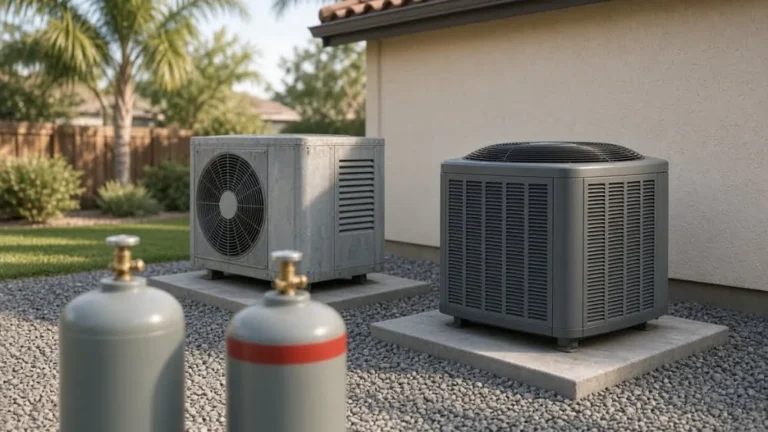
The first rule sets a January 1, 2026, deadline for installing leftover R-410A equipment made before 2025. On May 21, 2026, the EPA removed this deadline for residential and light-commercial systems because of R-454B supply shortages.
The change was published on May 26, 2026, and took effect on July 27, 2026. Now, pre-2025 R-410A equipment can be installed at any time. This does not mean manufacturing has restarted, and it does not change the rules for servicing systems already in your home.
Yes, A2L refrigerant is safe when installed and serviced properly. A2L means it is mildly flammable, but not dangerous or explosive. On the ASHRAE safety scale, it is between A1 (non-flammable, like R-410A) and the more hazardous A2 and A3 classes, but much closer to A1.
Equipment using A2L refrigerants is designed for that type, with charge limits, leak detection, and special installation practices as needed. Inside your home, a properly installed A2L system works just like any other central AC or mini-split.
The main differences are in how technicians handle the equipment, so it’s imperative that your technician has EPA Section 608 certification and manufacturer training.
Low refrigerant always means a leak, not used up. AC systems are sealed and do not lose refrigerant during normal use, unlike car oil. If your system needs more refrigerant, it may be leaking somewhere in the line set, coil, or fitting.
Simply adding refrigerant does not solve the problem and will likely cost you again soon. A proper service visit will check the refrigerant type, find the leak, and explain your repair options before adding more coolant.
The diagnostic fee is $95 and will be credited toward any repair you approve, so it is not an extra charge. Standard repairs, including leak fixes, usually cost between $150 and $650. More complex refrigeration or component work can cost $1,200 to $2,800 or more.
We do not list per-pound refrigerant prices here because the cost depends on how much is needed and current market rates. For more details, see AC repair service.
Most recently installed ducted central AC and heat pump systems use R-454B, while most new ductless mini-splits use R-32. Both have a lower GWP than R-410A, but you cannot swap one for the other.
Manufacturers usually follow this ducted-versus-ductless pattern, including the Mitsubishi Electric mini-splits we install, but it varies by model and year. The most accurate way to know what your system uses is to check the equipment nameplate, not just the brand.
Refrigerant compatibility is more than just the type of refrigerant. It depends on the compressor, metering devices, pressure ratings, oil, and safety controls the system was designed for.
A technician cannot convert an R-410A system to R-454B or R-32 by changing the refrigerant, and mixing refrigerants is neither safe nor effective. If you are considering a mini-split for a room without ductwork, see the ductless mini-split installation.
If your R-410A system is working, it will continue to cool your home just as before. The refrigerant change does not affect how your system operates each day.
Regular repairs are still available, and technicians can continue to service R-410A equipment. There is no need to replace a system that works well.
“You have to replace your R-410A system because of the new law.” No federal or California rule requires replacing a working system over the refrigerant transition.
“R-410A is illegal now.” It isn’t. Existing systems remain legal to operate and service.
“We can convert your existing system to R-454B.” The conversion isn’t a simple swap; it involves a compressor, metering, and safety design that the current system wasn’t built around.
“We’ll just add some refrigerant.” Without first finding and fixing the leak, this gets billed again later.
“A2L refrigerant is too dangerous for a home.” A2L equipment is designed and listed specifically for safe residential use.
“You must replace your system before 2026.” There was never a deadline requiring replacement, and the one installation deadline for leftover R-410A inventory was removed in 2026.
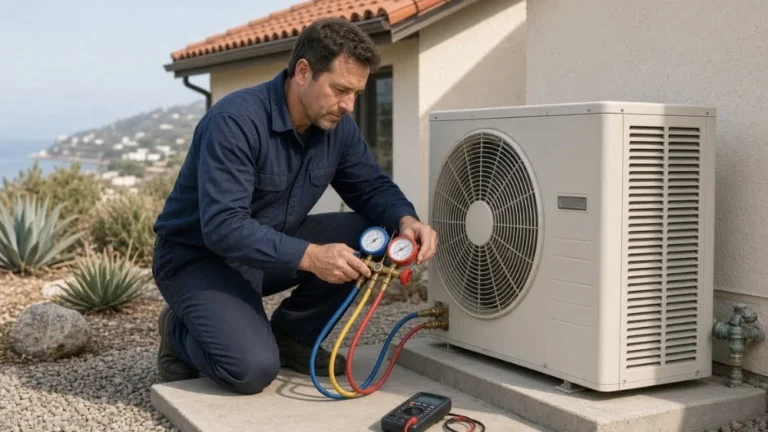
In the San Fernando Valley, AC systems usually run for six to eight months each year, longer than the national average. This means more hours of use and a higher chance of slow leaks developing.
Older homes in the Valley, especially in Chatsworth, often have long line sets and limited attic access. This can make leak repairs more challenging.
Coastal Ventura County homes face a different issue: salty air accelerates corrosion on outdoor components, which can lead to leaks in fittings and coils over time.
During diagnosis, it is also critical to look for wildfire smoke and dust buildup, since dirty coils can sometimes appear to be a refrigerant problem.
If you are thinking about replacing your system after a repair, remember that incentives vary by utility area. LADWP rebates are only for LADWP customers. Ventura County is served by SCE and 3C-REN, so LADWP rebates do not apply there.
For more details, see California HVAC rebates and our Ventura County page, including Simi Valley AC repair.
Most new ducted systems use R-454B, and most updated ductless mini-splits use R-32. Both replaced R-410A after manufacturers stopped producing R-410A equipment on January 1, 2025.
No. A working R-410A system remains legal to own, operate, and service. The transition applies to newly manufactured equipment, not installed systems.
Yes. Existing R-410A systems can be legally serviced, repaired, and recharged by a certified technician.
Yes, but low refrigerant generally means leaks. The leaks should be identified and addressed as part of the repair, not skipped for topping off the charge.
R-454B is classified A2L, meaning mildly flammable, not dangerous or explosive. The equipment used is designed and listed according to that safety classification.
Both are low-GWP refrigerants. R-454B is more common in new ducted systems, while R-32 is more common in new mini-splits. Neither is a drop-in replacement for R-410A nor the other.
No. Refrigerant compatibility depends on the compressor, metering device, and safety design the existing system was engineered around.
The latest equipment uses different refrigerants and, for all A2L systems, updated handling requirements are reflected in current costs. This is separate from servicing an existing R-410A system, which doesn’t require a system upgrade.
If your system is low on refrigerant or someone told you to replace it because of a refrigerant change, a diagnostic visit will give you a real answer rather than a guess.
The $95 fee is credited toward any repair you approve, and you will get a written quote before the work is done. We will be honest about whether repair or replacement is the better choice.
Los Angeles County: (818) 722-1332 Ventura County: (805) 755-4074 Book an appointment online
Affordable Heating and Air is a woman-owned company with a California CSLB license #1081403, with EPA Section 608 certified technicians and NATE-certified staff. We’re currently rated 4.9 stars from over 1,678 Google reviews at our Los Angeles County office in Chatsworth.